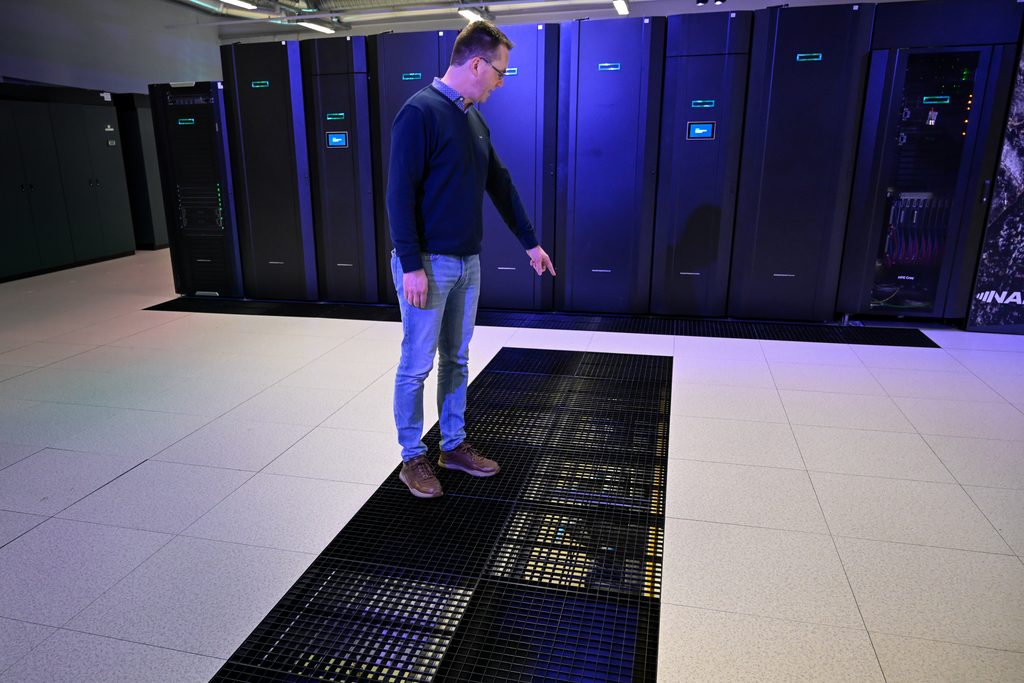
Behind the racks: The infrastructure that keeps the supercomputers running
By Rebecca Forsberg, Science Writer
If you ever have the opportunity to visit a computer hall, your attention probably, naturally, goes to the computers themselves: rows of buzzing cabinets packed with processors performing billions upon billions of calculations. But that is only part of the infrastructure behind a high-performance computing centre.
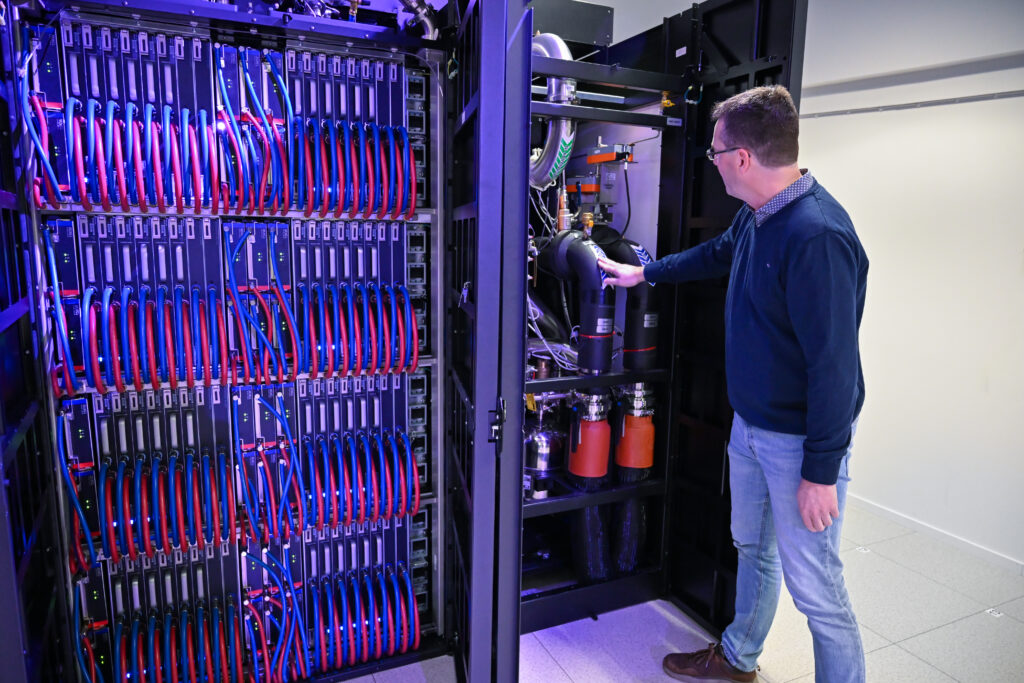
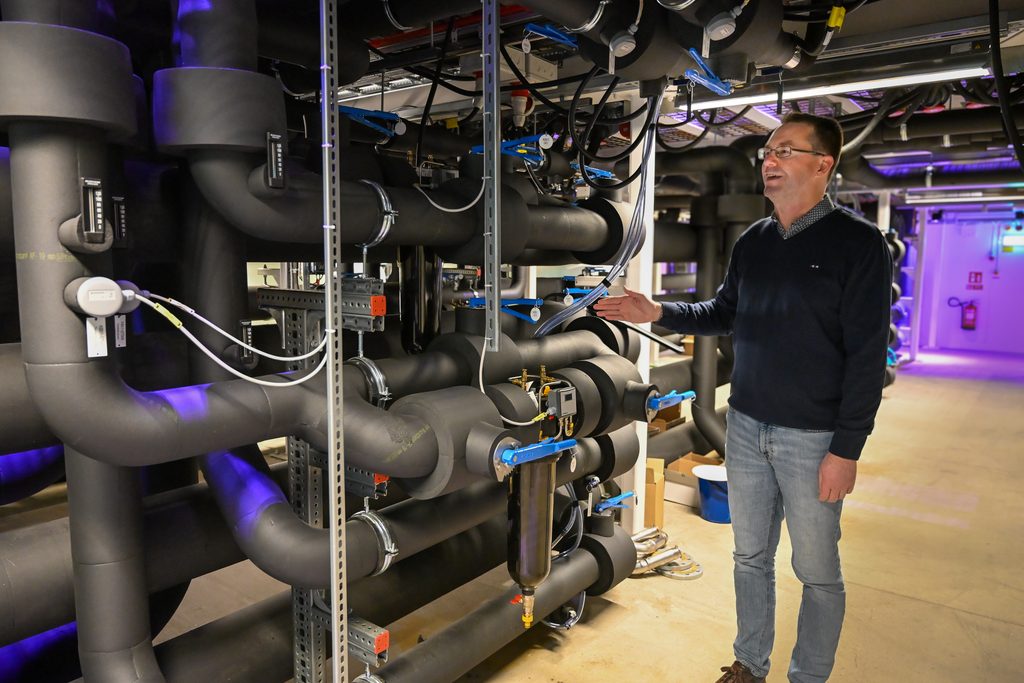
Here at our data centre in Linköping, the newly installed Arrhenius computer occupies one floor. Beneath and behind it is a system of pipes, pumps and cooling equipment. It may be in the background, literally and figuratively, but it’s essential to keeping the computers running.
“When we show the infrastructure, most people head straight upstairs, where the computers are,” says Andreas Johansson, technical director at NAISS. “But the rooms behind the system and on the ground floor, where the cooling systems are, are just as important a part of the infrastructure.”
From electricity to calculations to heat
A supercomputer uses electricity to perform calculations, and that energy ultimately becomes heat. The more intensively the hardware works, the more heat is generated and needs to be carried away from the electronics as efficiently as possible. This means that cooling is a fundamental part of high-performance computing.
For NAISS’s newest systems, much of the cooling happens with water. The infrastructure includes water circuits, heat exchangers and district cooling from the municipality utility company in Linköping, Tekniska verken, with closed water loops circulating through the facility.
“Instead of having new, fresh water running through the system, the closed loop means we reuse all the water,” Andreas explains. Whilst that saves water, it also comes with its own difficulties. The water in the cooling system is not so cool after all, but around 30–40 degrees Celsius. “That’s quite cosy if you’re algae or other microbial life. After roughly four years, the whole water system needs a thorough cleaning to stay efficient,” says Andreas.
More than performance per watt
In a recent study of a water-cooled data centre operated by Ericsson, researchers at Linköping University and the University of Gävle determined that server operation and process cooling together accounted for 95 percent of the energy used in the computer hall. Whilst the exact balance differs between facilities, researcher Vlatko Milić, lead author of the study, says that assessing energy efficiency means looking beyond the servers themselves.
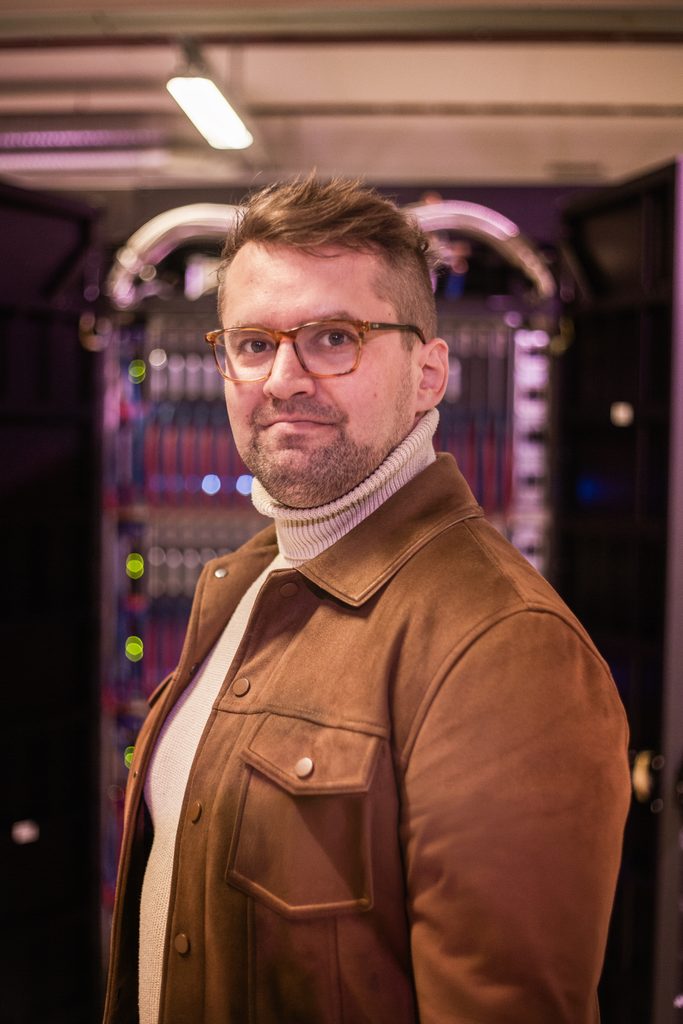
“We need to look at the energy use of the entire data centre, not just the servers,” he says. “It is also important to relate the energy use to the work being performed.”
Arrhenius provides an interesting example of the latter. Its GPU partition ranks 24th on the November 2026 Green500 list, which compares supercomputers by how much computing performance they deliver for the power they consume. But this measures one particular kind of energy efficiency: how much computational performance the system delivers per watt. It does not, by itself, tell us how energy-efficient the entire data centre is.
That broader picture includes how efficiently the computers are cooled and the facility is operated. We have already covered that here at NAISS, closed water loops and district cooling help carry heat away from the computers. But once that heat has been removed, another question arises: can it be put to use?
While cities can make use of the surplus heat from data centres, Linköping already uses a high temperature heating system from Tekniska verken. “The resulting heated water that is returned from Arrhenius is a lower temperature than the return loop of the district heating. Heat pumps are required to bring up the temperature, which doesn’t always make financial sense. Nonetheless, we are still exploring possibilities with Akademiska Hus, which manages the university buildings, and Tekniska verken for making use of the surplus heat,” says Andreas.
Nonetheless, Vlatko Milić says that “a data centre can absolutely be energy-efficient even without heat recovery,” and points out that whether surplus heat can be reused depends not only on the data centre itself, but on the surrounding energy system, existing infrastructure and the local climate.
The impressive part of a supercomputer may be what happens inside its processors. But making those calculations possible requires an infrastructure working behind the scenes, continuously cooling the computers and carrying away the surplus heat. Without it, there would be no supercomputing.