Rocío Mercado Oropeza: Building AI tools to help design new molecules
Rocío Mercado Oropeza is heading AIME, the AI Laboratory for Molecular Engineering, at Chalmers. She and her team are developing generative AI tools which facilitate the design of new molecules. They rely on NAISS compute resources to train the models which underpin these tools.
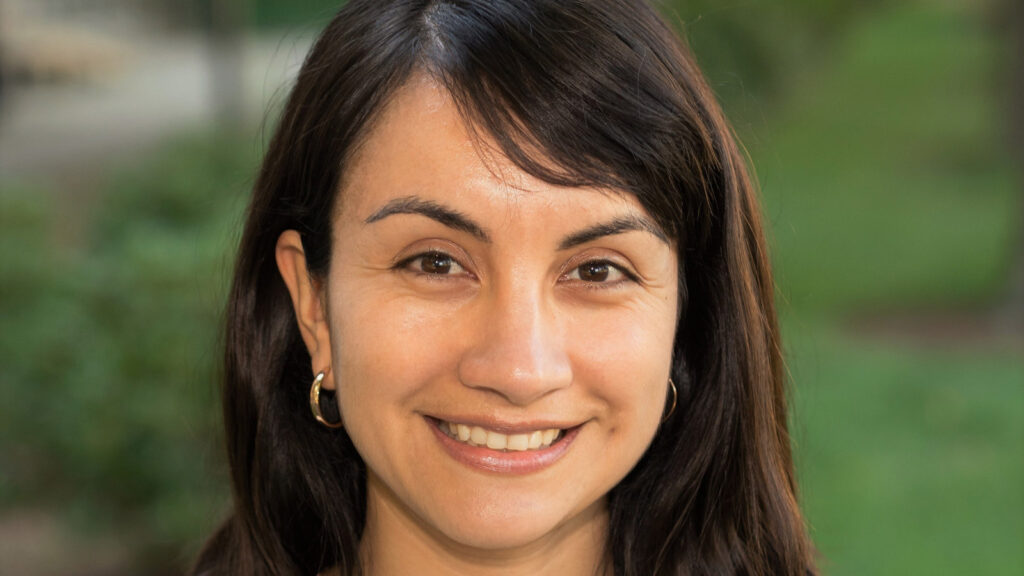
Rocío Mercado Oropeza, originally from California, came to Gothenburg in 2018 for a postdoc. Today she is an assistant professor at the Data Science and AI Division at Chalmers University of Technology where she is heading AIME, the AI Laboratory for Molecular Engineering.
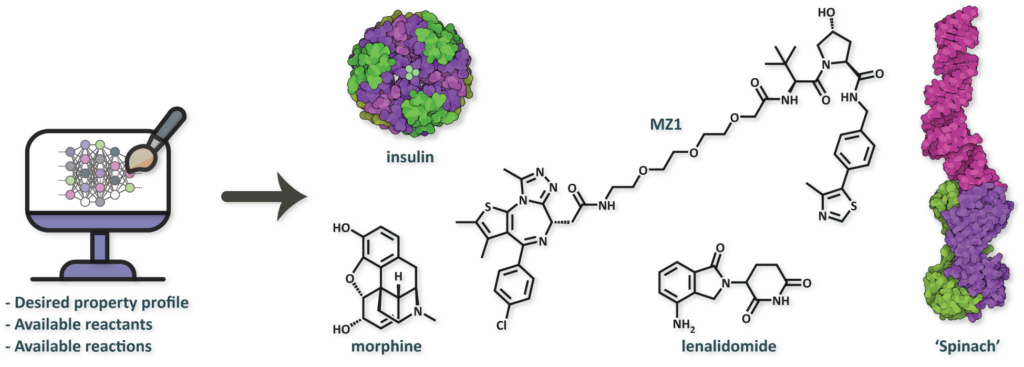
Her team is building generative AI tools that can be used to design molecules with specific properties and speed up the process of finding promising candidates for new materials or drugs. The applications are wide-ranging.
“We have 1033 possible drug-like compounds that could exist out there. How do we find the best ones for different kinds of diseases and so on, the best treatments? And that is where our tools come in. They are helping us design molecules that meet all of our desired constraints, or as many as possible, while also searching through this chemical space,” Rocío Mercado explains.
Model training requires large compute resources
All AIME tools are open source and shared on GitHub, free for anyone to use.
“That is very important to me and the collaborations I choose. Many of the use cases we do see of our tools are other academic groups. If people use them for business purposes then that’s great, but I’m not making any additional money off of this.”
Training the models which her tools are based on requires large compute resources, both CPU and GPU, across different stages of the development process. Her team has allocations on several NAISS systems.
Starting to figure out Berzelius
With deep molecular generative models, the molecules are treated as text, and there is an architecture with different weights. Training them efficiently requires at least GPUs, as they usually run into millions of data points.
“Sometimes we do a bit of molecular simulation to generate training data. For that we use Dardel which is dedicated for this, as opposed to Alvis which we use more for training of our machine-learning models.”
Since Dardel is quite crowded and is soon also being retired, AIME has increasingly started using the Wallenberg-funded Berzelius system. Rocío Mercado says it is a lot faster, but they have yet to figure out how to run all of their simulations on it.
Collaborations with Intel and Merck
AIME receives funding from many different sources, among them WASP (Wallenberg Autonomous Systems Program), WISE (Wallenberg Initiative Materials for Sustainability), and the Research Council. The group is also collaborating with Intel and Merck who are funding a PhD student and a postdoc on her team.
And in September 2025, Rocío Mercado was awarded the European Research Council’s prestigious EUR1.5 million Starting Grant, for a project about generative models for polymers.
“There are a lot of opportunities, and I was lucky to get many of them and recruit people to work on these various topics early on. Now I feel quite satisfied with the size of the team.”
Member of NAC
She recently also became a member of the NAISS National Allocation Committee (NAC), which evaluates proposals and decides which projects should be granted NAISS resources. They lacked someone with a background in a computer science department and who had experience in machine learning and invited her to join.
She is happy that she accepted, saying the experience has been insightful.
“I’m not trying to, like, overturn anything yet. I’m still learning.”
Learn more about AIME here.