Beyond the Nobel Prize: Simulating the next generation of IceCube
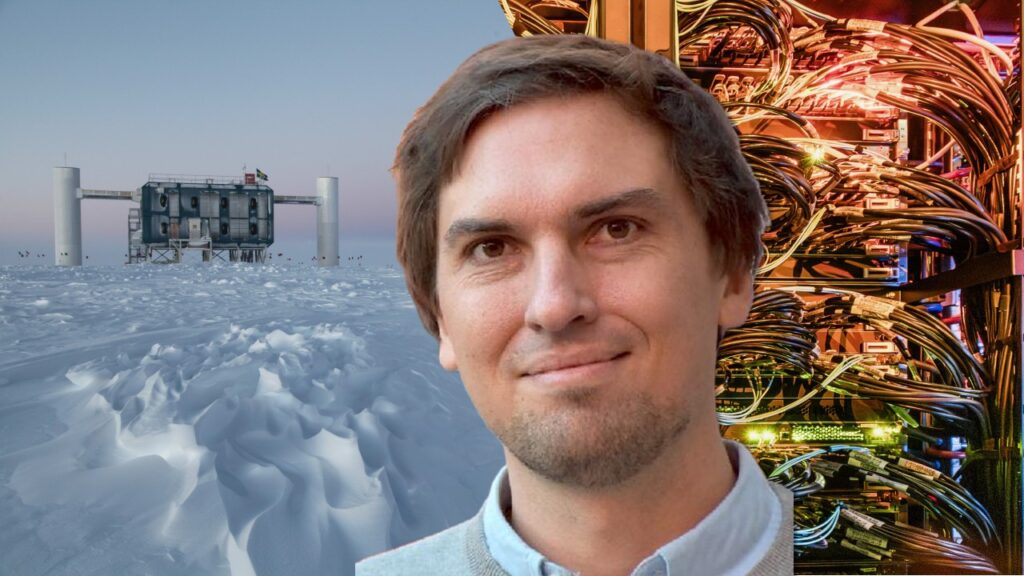
A Nobel Prize can mark a scientific breakthrough, but rarely the end of the story. For Christian Glaser, exploring what comes next relies on high-performance computing. Using NAISS resources, he is optimising the radio detector for IceCube-Gen2, the planned successor to the IceCube Neutrino Observatory.
Neutrinos are among the most elusive particles in the Universe. They interact so weakly with matter that enormous detectors are needed to catch even a small number of them. That same property makes them valuable messengers from environments that are otherwise difficult to probe, offering scientists a way to study some of the most energetic phenomena in the Universe.
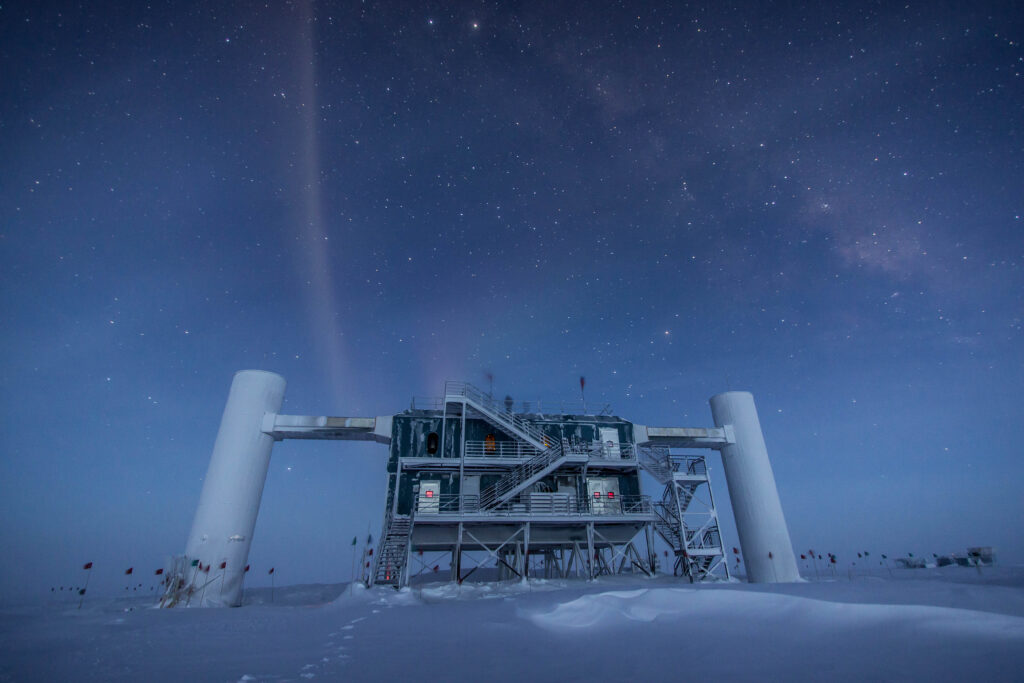
The IceCube Neutrino Observatory, located at the South Pole, has opened a new way of observing the Universe through high-energy neutrinos. Francis Halzen, who proposed the observatory, was awarded the 2026 Nobel Prize in Physics. Now, researchers are working towards its successor, IceCube-Gen2, and NAISS resources are helping researchers optimise the design of the future detector.
Christian Glaser, Associate Professor at Uppsala University, works on the design of the radio detector for IceCube-Gen2, and was thrilled to hear the announcement.
“I’m in a slight state of disbelief. Just a few weeks ago Francis and I were at the same meeting, stayed in the same hotel, and had breakfast together, and now he was awarded the Nobel Prize,” says Christian Glaser.
Designing a detector before it exists
Building a detector at the South Pole poses an obvious challenge: researchers need to understand how well different designs will work before anything is constructed. This is where large-scale simulations become essential.
In his NAISS-supported project, Christian Glaser and his colleagues work on optimising the detector layout, developing reconstruction and analysis techniques using deep learning, and simulating how neutrino signals are affected by the polar ice. By simulating different detector designs, they can optimise IceCube-Gen2 to increase its sensitivity to cosmic neutrinos and improve its ability to reconstruct their direction and energy.
“The IceCube detector is so complex that essentially all data analysis relies on simulations. We cannot calculate a theoretical prediction with pen and paper but need to run extensive Monte Carlo simulations, simulating the neutrino interactions, the development of particle cascades, the light and radio emission they produce, the propagation through the ice, and finally the detector response”, says Christian Glaser.
“The final detector design of IceCube-Gen2’s radio component is largely based on simulations run on NAISS supported resources”, says Christian Glaser, who has been using the Dardel and the UPPMAX compute cluster, now migrated to Arrhenius, and with simulated data stored on Klemming.
High-performance computing changes what can be studied
Christian Glaser explains that access to high-performance computing not only makes calculations faster, but also gives them the possibility to investigate scientific questions that otherwise would be too impractical to pursue.
For example his team developed a deep neural network to determine properties of cosmic neutrinos from the complex data expected from IceCube-Gen2. Training it required a large quantity of simulated data, which they produced using NAISS resources.
“NAISS enables internationally competitive research in the first place. Without NAISS resources, we wouldn’t have been able to produce enough Monte Carlo simulations needed for the neural network training,” says Christian Glaser.
As IceCube-Gen2 moves from simulation towards a future observatory, high-performance computing is already helping shape what that observatory could become. With NAISS resources, researchers can test and refine ideas computationally before a new generation of neutrino detectors is placed in the Antarctic ice.
More details on Christian Glaser’s research
NAISS medium project “Simulating radio emission of high-energy neutrinos”
More user stories